
This blog has been a long time coming, but I didn’t know that I would have to go on vacation for it to fully materialize. I spend a lot of time trying to connect people to the Santa Cruz River, neglecting that I needed to connect with nature myself. I would find my inspiration by going on a North American “safari” to see 16 different mammal species in the span of 48 hours in one of the most wild and scenic places in the US—Yellowstone National Park!
I have been to Yellowstone twice before, but I have never seen so many mammals in such a short amount of time. Yes, I saw the bison, pronghorn, and bears (both grizzly and black), but I saw the more secretive bighorn sheep, badgers, and muskrats too! If seeing a badger wasn’t enough, I got to watch one chase a coyote multiple times. Seeing them was magical and I couldn’t help but notice the smiles on the faces of all the other park visitors.
So, how does this relate to my work in the Santa Cruz River watershed? Well, I kept thinking about all the wildlife I saw, how they had room to roam, and pondered how we could create more space for all wildlife in the watershed. I realized that Sonoran Institute has already been working on this, by helping protect some large landscapes in the watershed like Las Cienegas National Conservation Area and the San Rafael Valley.
More specifically—and the reason I’ve been wanting to write this blog—when Sonoran Institute was founded, we were trying to figure out how to balance development and growth with the protection and stewardship of the surrounding open space. One idea was to work with large developers who would preserve open space around and throughout a residential subdivision. This open space would then be managed by a conservation stewardship organization who would be funded by the sales of the homes. This concept was launched a few different times, but I want to focus on one.
Sometime in the early 2000s, Sonoran Institute connected with a developer planning a big project just north of Patagonia, Arizona. The idea was to build the Three Canyons Subdivision and the Three Canyons Estates as a conservation-focused development, where the open space around the houses would be protected with a conservation easement and managed to preserve the wildlife diversity and health of the surrounding watershed. A conservation easement is a voluntary, legal agreement that permanently limits uses of the land to protect its conservation values. In this case, a large portion of the property (over 48% or 892 acres) would be put under an easement to protect this open space into perpetuity and limit the amount of land that could be developed or “improved” for human use. The locations where houses and other improvements (other than roads and utilities) were limited to 65 acres, or only 4% of the total 1,701 acres—further reflecting this commitment to preserving open space.
Sonoran Institute was very interested in this project and agreed to hold the conservation easement, signing the deed document in December 2005. The developer continued to work on the foundation of the project by building roads and utilities for the first phase. Meanwhile, we created La Semilla (Spanish for “the seed”), the conservation stewardship organization, and even hired a staff person who would get things started. We planned to be ready for when the development really picked up momentum.
Though several lots in phase 1 of the subdivision sold, in 2008, the economy crashed, and everything ground to a halt. I started working for Sonoran Institute in fall of 2007, and I remember hearing about this Three Canyons project and toured the area. I was going to support La Semilla as they developed small scale projects to address erosion on the property. But sales of the lots slowed and no houses were built. Eventually La Semilla came to an end with the realization that the project wasn’t going to come about as planned. And that part of my job was largely put on hold.
Soon after the Sonoran Institute signed the deed of conservation easement, The Arizona Wildlife Linkages Workgroup (a multi-partner collaboration led by Arizona Department of Transportation and Arizona Game and Fish Department) released a statewide report identifying key wildlife corridors or linkages that should be protected to help wildlife move freely and help connect large blocks of public land. This report would end up playing a key role in the reimagining of the development because one of these corridors, the Sonoita Creek Wildlife Corridor (known as Linkage 96 Patagonia – Santa Rita in the report), crossed through the Three Canyons subdivision.
Fast forward 10 years to when bankruptcy results in Wildlife Corridors LLC purchasing the subdivision portion of Three Canyons in 2015. Wildlife Corridors, a sister organization to Borderlands Restoration Network, knew of the 2006 linkages report and saw that the densest part of the subdivision had been planned for the heart of the corridor. Realizing that dense development was not a good fit with wildlife movement, they began implementing a modified plan: continuing to sell the lots in phase 1, now called Wildlife Haven, but turning the rest of the development into a preserve.
Since 2016, ten amendments to the conservation easement have been recorded that eliminate the building rights, thus expanding the open space and increasing the conservation value of the property. And now 140 parcels (covering an area of 1,010 acres) that would have been developed now form the core of the Borderlands Wildlife Preserve managed by Borderlands Restoration Network. Wildlife cameras in the preserve have captured 22 mammal species and 12 bird species. In 2025, the area scored a rare “skunk bingo” by documenting all four species of skunk (Striped skunk, Western spotted skunk, Hog-nosed skunk, Hooded skunk). Both mule deer and white-tailed deer were also found, which is also uncommon.
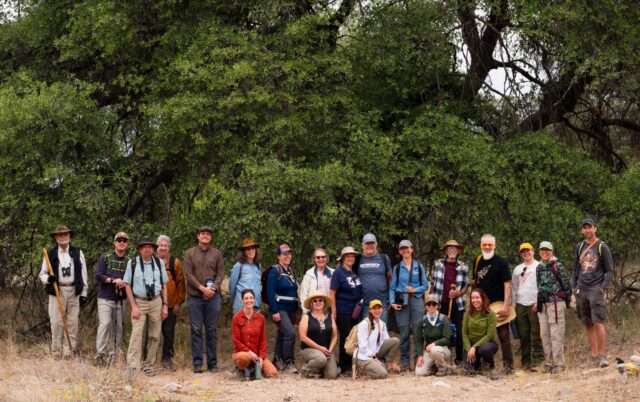
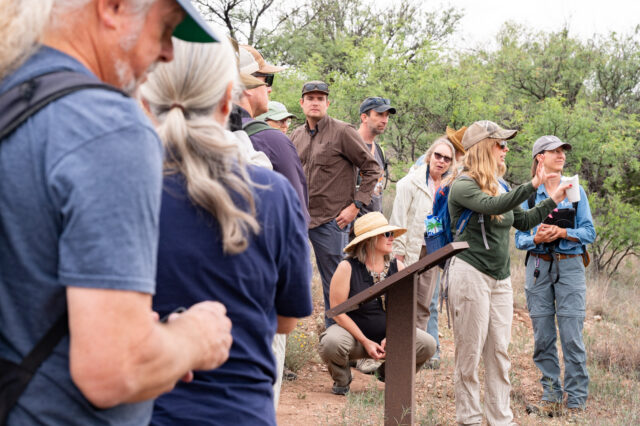
Fast forward again to today, when people can hike through this preserve on a few different trails, watch wildlife, and connect with this well preserved area. We hosted a hike with Borderlands Restoration Network this past April as part of this year’s Santa Cruz River Research Days. The conference theme was “A Watershed of Protection” reflecting on the 25th anniversary of the Sonoran Desert Conservation Plan and other large landscape conservation efforts. Being the 20th anniversary of our holding of the Three Canyons conservation easement, it was perfect timing to reflect on the important work being done in this part of the watershed. 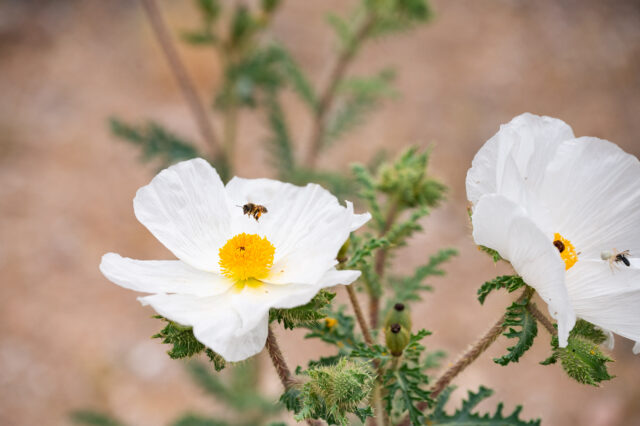
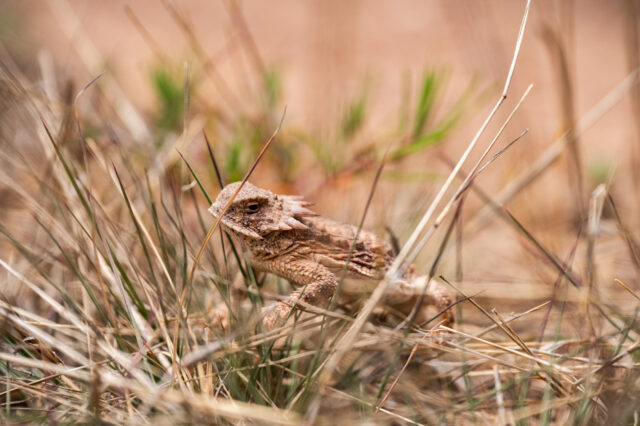
The Smith Canyon Loop does not disappoint. With scenic vistas and interpretive signage, it’s the perfect way to begin exploring this area. We had gorgeous overcast weather (a big plus in late April), a variety of colorful wildflowers, and even close-up views of a regal horned lizard (Phrynosoma solare). And, just as I saw in Yellowstone, everyone was smiling. Afterall, these protected areas and corridors are important for wildlife AND people. So cheers to all the regional efforts working hard to protect places in the Santa Cruz River watershed and to the next 20 years of the Borderlands Wildlife Refuge!
_________________________________________________________________________
Written by Claire Zugmeyer, Ecologist for the Santa Cruz River Program
Photos by Spencer Harding, Tucson photographer


