Every year, Santa Cruz River Research Days brings together a remarkable community of scientists, students, public agencies, nonprofit organizations, artists, and local residents who care deeply about the future of the river. After experiencing the event for the first time in 2025, I already knew how meaningful this gathering could be. But the 2026 symposium reminded me again that Research Days is much more than a conference; it is a space where knowledge, collaboration, and shared responsibility come together around one of southern Arizona’s most important living systems.
Held April 28–30 as a hybrid in-person and virtual event at Pima Community College’s Downtown Campus in Tucson, this year’s theme was “A Watershed of Protection.” The theme invited us to reflect on the policies, partnerships, science, and community leadership that have helped protect the Santa Cruz River and its surrounding landscapes over time. It also created a timely moment to recognize major conservation milestones, including the 25th anniversary of the Sonoran Desert Conservation Plan and the long-term protection of the river’s headwaters in the San Rafael Valley.
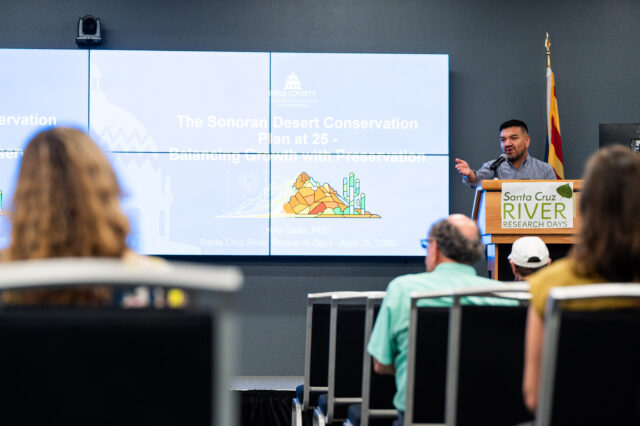
The event opened with two keynote speakers who helped frame the importance of sustained conservation leadership. Dr. Kris Gade, Director of Pima County’s Department of Conservation Lands and Resources, shared a perspective shaped by decades of work at the intersection of ecology, public planning, and wildlife connectivity. Pima County Supervisor Andrés Cano also addressed the audience, bringing attention to the importance of public investment, regional collaboration, and long-term stewardship in shaping a more resilient future for our communities and natural resources.

Throughout the conferences, I was struck by the diversity of presentations and the way they connected technical work with larger questions about community, access, and the future of the watershed. One presentation that stood out was Garrett Smith’s work on two GIS-based models designed to identify areas for conservation and rewilding along the urban Santa Cruz River corridor.


Another important thread throughout this year’s event was the future of river restoration. Kevin Payne of Kimley-Horn presented the ongoing development of a process-based restoration master plan for the effluent-dependent Santa Cruz River between Oso Wash and Green Valley. The work focuses on understanding existing river conditions, identifying restoration opportunities, and prioritizing projects that are both ecologically meaningful and feasible to implement. Nik Carlson of AECOM complemented that discussion by presenting an economic benefit evaluation of river restoration, highlighting how ecological improvements, groundwater recharge, recreation, and other public benefits can help strengthen the case for future investment.


The program also made space for community-centered water issues. Caylyn Rich from the University of Arizona shared work using pláticas (talks), or guided community conversations, to better understand household and community experiences with water insecurity across southern Arizona. Her presentation emphasized that water planning should not only be built from technical models and infrastructure needs. It also needs to listen carefully to the lived experiences of the people most affected by water uncertainty. That perspective felt especially important in a region where questions of access, affordability, and resilience are becoming more urgent.


Education and cultural connection were also strongly present. Melisa Bohlman and Mabel Rivera from Pima County Environmental Education shared how youth engagement, art, and river-based learning can help build the next generation of Santa Cruz River stewards (I love to be part of this exercise). Their work reminded us that long-term protection begins with helping people know the river, value it, and see themselves as part of its future. The conferences also included poetry from Barrio Kroeger Lane and Favor Celestial, as well as a presentation on Sonoran Rivers: A Celebration of Desert Water, an artistic collaboration that used music and community engagement to explore water scarcity, restoration, and sense of place in the Sonoran Desert.
Several presentations focused on the river as habitat and on the species that depend on it. Dr. Michael Bogan shared research on native and non-native turtle populations along the effluent-dependent Santa Cruz River, including encouraging results from turtle translocation efforts in downtown Tucson. Rocío Guzmán and Scully Young presented long-term studies of aquatic invertebrates, showing how water quality, flow stability, flooding, and drying shape biological communities in different river reaches.
This year, I also had the honor to share work on Oso Wash, a binational tributary to the Santa Cruz River that receives wastewater-influenced flows from Nogales, Sonora, before crossing into the United States. My presentation focused on the environmental concerns associated with treated and untreated wastewater entering the wash, as well as the efforts underway on both sides of the border to better understand the problem and identify opportunities to improve riparian conditions.


Beyond the presentations, one of the most valuable parts of Research Days is always the sense of community it creates. Attendee feedback from this year reflected that clearly, participants appreciated the variety of topics, the opportunity to network, the inclusion of virtual access and interpretation, and the way the event brought together local and binational perspectives in one place. Many also expressed interest in continuing to expand conversations on effluent, water reuse, government involvement, grassroots action, and student participation in future years.

I am grateful to have been part of another Research Days and proud of the role the Sonoran Institute plays in convening this community. The Santa Cruz River continues to teach us that protection is not a single action. It is a long-term commitment, carried forward by many people working together with care, persistence, and hope.
View this year’s recordings in English [Day 1, day 2 morning, day 2 afternoon] or Español [Día 1, día 2 mañana, día 2 tarde].
Check out proceedings and presentations from this and past events at www.tiny.cc/SCRRD_Archive
Search “Research Days 2026” in our search bar to explore more.
By Alex Corral, Santa Cruz River Program Manager, Sonoran Institute